Ghetto Blast: Lompoc Wine Alliance to Host Inaugural Feast

by Gabe Saglie, Senior Editor, Travelzoo
photos by Bob Dickey
story published in the Santa Barbara News-Press on 9/10/15

The history of Lompoc winemaking takes a big step forward this month.  The Lompoc Wine Alliance – a cluster of 25 wineries and tasting rooms tucked into some of the western-most reaches of Santa Barbara wine country – have just gained non-profit status.  And now, as a cohesive and organized group, the march is on to rev up promotion and heighten its visibility.

Fiddlehead winemaker Kathy Joseph mans a forklift in the Ghetto
“The banding together of these 25 wineries is significant,” says Kate Griffith, who’s on the board of the new Lompoc Wine Alliance.  She also does marketing for Flying Goat Cellars, the popular pinot noir and sparkling wine label that she runs with her husband, winemaker Norm Yost.  “We are one of the largest concentration of high-end small producers in the county, and possibly in the state.”

And that’s not a stretch, especially when you read through the roster of winemakers who call Lompoc home.
 
The hub of Lompoc winemaking is the Sobhani Industrial Park, a no-frills complex along E. Chestnut Avenue, between N. 7th and N. 12th Streets, that’s affectionately come to be known as the Wine Ghetto.   The focus here is clearly on functionality and efficiency, not style or décor.  There’s certainly charm here – in the tasting rooms, practical use of space is often balanced by delightful touches.  But the attention, in the end, is squarely on the wine.
 
Rick Longoria
Local wine pioneer Rick Longoria, in an ingenious move, opened up the first winery in the Ghetto in 1998 (he recently moved his tasting room to a pretty spot about a mile away).  But it was with the arrival of wine phenom and Palmina founder Steve Clifton in 2005 that the propagation of small production facilities that doubled as tasting rooms began in earnest.  Fiddlehead and Flying Goat arrived soon after.
 
Today, with the Ghetto is its nucleus, Lompoc has seen a handful of other wineries and tasting rooms pop open around town.  The 25 members of the Lompoc Wine Alliance include all those innovator names -- Longoria, Clifton, Yost, Fiddlehead’s Kathy Joseph, Ampelos’ Peter Work – as well as some of the area’s most exciting new labels, like Bratcher, Kessler-Haak, De Su Propia Cosecha, Justin Willett’s Tyler and Gavin Chanin’s LUTUM.

Steve Clifton, center
Lompoc’s affair with winemaking goes way back, of course.  The padres at La Purisima Mission cultivated their own grapevines at the turn of the 19th century.  When Lompoc was founded in the 1870s, it was actually designated a temperance community; that experiment fizzled within a decade, though, made moot  by the widespread home winemaking endeavors of the immigrants who’d moved here.  Pedigree wine growing arrived in the early 1970s – a blend of intuition and serendipity – when Richard Sanford and Pierre Lafond planted vineyards that thrive to this day.  The Sta. Rita Hills AVA, with Lompoc as its home base, gained federal recognition (and serious attention from an entire industry) in 2001.

The newly formed Lompoc Wine Alliance, then, is the latest chapter.  And, to celebrate, it’s throwing a party.  Harvest in the Wine Ghetto is taking place September 26 and 27 and will feature barrel tastings, open houses, seminars and a signature dinner.  Events can be purchased separately: the Saturday grape stomp and live graffiti demonstration, which includes a tasting flight at any participating winery, is $15; exclusive barrel tastings at three wineries of your choice is $40 (Yost tells me he’ll likely be sampling his 2014 pinots from Bien Nacido and Rio Vista Vineyards); the Saturday night wine dinner with Bell Street Farms, in the tradition of the La Paulee harvest dinners thrown by vintners in Burgundy and slated to be held in the Wine Ghetto parking lot, is $125.  The Weekend Pass, which includes all events at a savings, is $160.
 
For tickets and more information, check out www.lompocwine.net.

###

California Made, French Inspired: New Bacara Chef Bring Parisian Flair to the Kitchen

by Gabe Saglie, Senior Editor, Travelzoo
story published in the Santa Barbara News-Press on 9/3/15


Bacara Executive Chef Vincent Lesage
When Chef Vincent Lesage takes the spotlight at this year’s Taste of the Town – in a pair of events that includes a deluxe VIP dinner and a gourmet tasting – it’ll double as his public debut.
 
“I am honored by this,” says the French native, who took the helm as the new Executive Chef at Bacara Resort & Spa just four months ago.  “And I’m very excited to be part of this major culinary event for the first time.”
 
As Lead Chef for the 34th annual Taste of the Town, a landmark culinary fete that draws more than 1000 foodies and benefits the Arthritis Foundation of Greater L.A. and the Central Coast, Chef Lesage will be wearing multiple hats next week.  On Friday, September 11th, he’ll wow palates at the Connoisseurs’ Circle event, a gala dinner affair for sponsors and their guests at Bacara.  The menu, which the chef calls “very French oriented,” features a starter of roasted beets, pickled Cavaillon melons and a goat cheese cream and a main course of pan-seared filet of beef, encrusted in foie gras and grape crust, and doled out with sautéed wild mushrooms and asparagus.
 
Winemaker Fred Brand and his son Nik
at the 2014 Taste of the Town
“We’re using many local ingredients,” says Chef Lesage, who’ll receive a special award that night.
 
“While this will be our 6th annual Connoisseurs’ Circle, it is the event’s inaugural year at Bacara Resort & Spa,” says Arthritis Foundation Executive Director Asher Garfinkel, who adds that only a few seats to this VIP affair remain.  “We agreed that honoring Chef Lesage and featuring his talent makes perfect sense, given our simultaneous new arrival at Bacara.”

The evening’s honored winemaker will be Fred Brander, of Los Olivos’ Brander Vineyard, who’ll match a wine with each course.

On Sunday, September 13th, Chef Lesage will be hosting a tasting station and mingling with guests at the signature Taste of the Town event, an open-air extravaganza on the Riviera foothills that features dozens of chefs, caterers and winemakers.  The event, which sells out each year, takes place from Noon to 3pm.  Tickets are $125.

Though a new transplant to Santa Barbara, Chef Lesage is not new to fine food.  He was born and raised in Paris, and although he didn’t grow up in a gastronomic household – his father worked at a supermarket and his mother was a teacher – he does remember cooking often with his grandmother.  “I knew from a very young age what I wanted to do."
 
As a teenager, Mr. Lesage headed south and spent two intensive years at Institut Paul Bocuse, a prominent culinary school in Lyon, “the world’s capital of gastronomy,” he says.  He’d go on to cut his teeth at several renowned restaurants, like Restaurant Bras, in southern France, and Restaurant Astrance, in Paris.  Both are prestigious three-star Michelin eateries.  Chef Lesage worked at The Ritz Paris, too.
 
The September 13th Taste of the Town event will take place at Santa Barbara's Riviera Park
“So my background is very traditional,” he asserts.  “Where I’m from, you sit down with your family every time when you have a meal.  You don’t always find that in America.”  But since his move to the U.S. seven years ago, Mr. Lesage admits that this country’s epicurean interests appear to be shifting.  “People are more and more into restaurants as an experience – wanting to make sure the way they are treated is just as important as the wine and the food,” he says.  “And people are more into organic and into local now, and that is great to see.”
 
Chef Lesage was hired by Starwood Hotels as Executive Sous Chef for the AAA 5-Diamond St. Regis Monarch Beach in 2008, where he managed a kitchen staff of more than 60.  He went on to serve as Executive Chef of the deluxe Balboa Bay Resort in Newport Beach, where he launched two waterfront restaurants, Waterline and A&O Kitchen Bar.  Balboa Bay Resort is managed by Pacific Hospitality Group, which also operates Bacara.
 
Chef Lesage arrives at Bacara at a pivotal time in the culinary history of the seaside Forbes 4-Star resort.  Miro, its flagship restaurant, is closing and undergoing a $3.5 million renovation to make way for a new restaurant in the spring of 2016.  The concept remains a secret, but “the focus will be on raw materials, on earth and water,” reveals the chef.  Over the next year, the property’s five other eateries will be revamped, too, which suits Mr. Lesage just fine.  “I like variety,” he says.  “The more that’s changing, the better.”
 
It’s an attitude that extends into the kitchen.
 
“I love our proximity to ingredients – we’re within three miles to almost everything – and we have lots of great seafood,” says Chef Lesage.  “But more importantly, we have to be ready to do everything.  At Bacara, we could be cooking French today, and tomorrow it could be Chinese.  There’s huge diversity.  And we have to be driven and we have to be extremely good in everything we do.
 
That push for perfection seems natural in Mr. Lesage, though he’s quick to recognize the critical role social media plays today in keeping the bar high.
 
The Bistro at Bacara Resort
“We’re put under the gun every day,” he says.  “Before, people would come to visit your restaurant three or four times.  Now the experience can be just one meal, and boom – they’re taking a picture, putting a hash-tag on it, putting it on social media and there you are!  It’s putting more and more pressure on chefs to deliver their best every day.”
 
This is where Chef Lesage’s youth – he’s only 30 – could be a real asset for Bacara, where his forward-looking ingenuity is already taking shape.  He’s partnered with Fairview Gardens to exchange all his kitchen scraps for homegrown fruits and vegetables.  “They realized their soils were in need of a revamp,” says the chef, “so instead of buying compost, we provide them with the ingredients to create their own.”
 
Richard Yates and Tina Takaya of Santa Barbara's popular
Opal Restaurant are the Honorary Chairs of the 2015 Taste of the Town
The Chef is also sourcing produce from one of Bacara’s nine fountains, which have been converted into gardens to conserve water; the one designed by Something Good Organics grows heirloom eggplant, basil, romaine lettuce and more.
 
Chef Vincent Lesage lives in Goleta with his wife, Ashley, and their two-year-old daughter, Olivia.  Thus far, their favorite family activities involve the great outdoors.  “We love doing nature-oriented things, like taking the dog, going to the beach and getting into the water to play,” he says.  “The climate here is pretty amazing.”
 
For more information on Bacara, go to www.BacaraResort.com.  For information and tickets to the 34th annual Taste of the Town, visit www.TasteoftheTownSantaBarbara.org.  For tickets to the Friday night VIP dinner at Bacara, contact the Arthritis Foundation office directly at 805.563.4685.
 
 
###

Raising the Bar: Dave Potter Goes High-End with New Wine Project

by Gabe Saglie, Senior Editor, Travelzoo
story published in the Santa Barbara News-Press on 8/27/15


Winemaker Dave Potter’s new venture is personal in more ways than one.
 
It’s close to home, for starters, which is a big boon for this 36-year-old dad.  “I live just three blocks away from here,” he told me when I visited his Potek Winery this week.  The facility – complete with tanks, barrels and tasting bar – is the first resident of The Mill, the new marketplace project on the corner of Haley and Laguna Streets in Santa Barbara’s eastside, on the former Tile Co. site, which will also see a brewery, restaurant and home goods store soon.  Potter’s been making the wine for his other labels – Municipal Winemakers and Goodland – in Buellton for years, until now.
 
Potek is also a tip of the hat to Potter’s heritage.  “My great-grandfather was from Romania,” he tells me as he sets up three glasses before me and begins to pour.  “And when he got to Ellis Island in 1917, they changed his name from Berl Potek to Benjamin Potter.”  A story that saw itself repeated many times over, of course.  For Potter, it’s one that inspired not only his pseudo-eponymous label, but the look and feel of his new workspace, too.  For Potek’s branding and design, “we researched traditional Romanian textiles and embroidery,” Potter says as I notice that the detailed clues around me abound, from the funky topography on the labels to the angled wooden tiles above the bar.
 
Potek is also personal in the way that it’s become a totally new creative outlet for Potter.  The former Fess Parker winemaker has already forged a strong following with his own Municipal Winemakers, a label with a Funk Zone tasting room and a reputation for vibrant, easy, value-driven wines.  Potek, on the other hand, is all about “the best wine that I can do,” he says.  “If Muni is our gastropub, Potek is our fine dining."
 
Potter is now doing all his winemaking at Potek
Indeed, these wines represent the best three to four barrels that Potter makes each vintage – quality all the way.  They're all vineyard-designate wines, too, with a production quotient that’s boutique-y – 700 cases a year right now – and price points that trend higher – between $30 and $65 a bottle.
 
French oak barrels abut the bar at Potek
"We age these wines a lot longer, though,” he tells me, as I sip on the 2013 Riesling from Kick On Ranch Vineyard ($30).  Unlike the crisp Riesling he makes under the Municipal label, which is released young, this one was fermented on the skins, like a red wine, and aged six months in bottle and 12 months in barrel before going public.  It’s delicious – creamy and rich while maintaining the grape’s classic freshness.
 
“The higher price points also mean we’re able to seek out fruit sources that are more lucrative,” Potter continues, as I move to the glass with the 2013 Pinot Noir ($60).  This one’s sourced from original plantings on Sanford & Benedict Vineyard in the Sta. Rita Hills – vines that date back to 1971.  “The epicenter of pinot noir in Santa Barbara County,” the winemaker adds.  Known as perhaps the most expensive pinot noir growing in the county right now, it’s a fruit source that’s always been out of reach for he lower-priced Municipal label.  Under Potek’s auspices, the grapes yield an enchanting wine – cherry-inspired with a silky, smooth texture and a layered, complex mouth feel.  Only 94 cases were made.
 
The current Potek lineup includes three wines, each poured into its own elegant glass
The 2012 Syrah ($45) comes from Tierra Alta Vineyard in Ballard Canyon and that same elegant, velvety palate impression prevails.  Rich and robust, yet pretty and smooth, with a fresh finish.
 
The tasting of three wines costs $15.  The current portfolio also includes a 2013 Rancho La Vina Pinot Noir ($50) from Sta. Rita Hills and a 2012 Tierra Alta Grenache ($40).  “We will add those to the flight soon,” Potter says.  The Potek crew also bottled a 2014 Bien Nacido Chardonnay on Monday, which will be released next spring.
 
As we wrap up, I congratulate Potter on what is an impressive new project -- impressive on the wines’ merit alone, for sure, but also on the way he’s achieved a refined wine drinking experience here, and on the way his personal story plays a big role.  “Yeah, I wanted this to be a lot about tradition and history and culture,” he says.  “Just like wine."
 
In the near future, Potek will be sharing a lovely outdoor courtyard with Third Window, a brewery project that involves Fess Parker’s grandson, Christopher, and Wildwood Kitchen, a barbecue concept by Chef Justin West, of Julienne fame.  The winery will sell wines by the glass for outdoor sipping and will feature private corners indoors for personalized tastings. Currently, the tasting bar is open everyday from Noon to 7pm.
 
Potek Winery, 406 E. Haley St., Santa Barbara, CA 93101.  (805) 598-1896.

 
###

Bye-Bye Bottle? Alternative Wine Packaging on the Rise

by Gabe Saglie, Senior Editor, Travelzoo
published in the Santa Barbara News-Press on 8/13/15


I enjoyed a lovely pinot noir over the weekend.  It was easy-drinking, with bright cherry flavors, earthiness and a clean finish.  Made from Central Coast fruit, it paired nicely with my wife’s homemade turkey tacos.

I also poured myself a tasty cabernet sauvignon.  It was smoky and robust.  And it was, impressively, sourced from French Camp in Paso Robles, the celebrated organic vineyard owned by Santa Barbara’s Miller family, who own and manage famed Bien Nacido Vineyard in Santa Maria, too.

What was especially unique about these wines, though, was not how they tasted, or their pedigree.  It was their packaging.  The pinot, on the new Alloy Wine Works label from San Luis Obispo County's Field Recordings, comes in an aluminum can, just like any inexpensive beer, complete with popable pull tab.  The cabernet comes inside a small cardboard box – a Tetra Pak is what the producer, CalNaturale, calls it.  You open it by twisting a small plastic cap.

I’ve always been a traditionalist; it took me a long time to embrace the industry’s slow move toward screwcaps.  So I balked, at first, at the notion of gulping wine from a can.  But these unique packages do come with perks.

Portability, for one: in this season of beach outings, picnics and camping trips, stuffing a few cans or small boxes of wine into your bag is easier to do, and more forgiving, than glass bottles.

And then there’s value.  I bought these wines at Nielsen’s Market in Solvang, which sells 500-ml. cans of Alloy – the pinot noir I mentioned as well as a grenache rosé – for $7.49.  That’s the equivalent of just over $11 for a standard 750-ml. bottle.  The 500-ml. box of cabernet from CalNaturale, the Northern California producer that also makes a boxed chardonnay, sells for $5.99 – that’s under $9 if it were a regular bottle, probably the lowest price for anything ever made from French Camp fruit.

You’re not supposed to really sip right out of the can, of course, or the box.  Question is, once you pour, does it really matter where the wine was housed from the time it left the barrel to the time it hit your glass?  For young wines meant to be drunk young, an aluminum or paper vessel is just as effective as glass.  Image issues aside, the only drawback of the can may be commitment: if you don’t want to finish the full 500 ml. of pinot, you’d have to get creative about closing the can back up.  The Tetra Pak cap recloses easily, though I don’t think the cab tasted quite as fresh on day two.

“I wish more producers started experimenting with these types of closures,” Ozzie Osmonson told me.  He’s the buyer for the impressive wine department at Nielsen’s, which features a variety of wine cans and boxes at two different store displays.  “You can do a lot more with a can than you can with a bottle, and they’re just a lot easier to use.”  As we part ways, the fundamentalist voice inside my head wants to argue.  Traditional bottles rule!  But I find myself agreeing.  And I find myself adding a Sofia sparkling wine to my stash as I head toward checkout; the pretty pink 187-ml. can fits perfectly in the palm of my hand, comes complete with a tiny straw and costs just $4.49.

Still not convinced?  Understandable.  But there’s no denying that the trend toward alternative wine packaging is growing.  The classic glass bottle isn’t going the way of the dodo bird anytime soon, but store shelves are getting increasingly more crowded with wine-filled cans and boxes of all shapes and sizes.  And at such competitive prices, pulling a tab or two may well we worth the experiment.


###

Schaefer on Wine: Those lazy, hazy, rosé days of summer

This marks another guest post on my personal blog.  Dennis Schaefer and I share wine columnist duties for the Santa Barbara News-Press, and his wine descriptions are always genuine, consumer-focused and on point.  Of the rosés featured here, I have to tip my own hat to the Tercero and the CrossBarn wines, which are remarkable both for their value and for the quintessential summer sipping they inspire.
-- Gabe Saglie, Senior Editor, Travelzoo


Story by Dennis Schaefer, published in the Santa Barbara News-Press on 8/20/15

In California, we drink rosé year-round, but it always seems to taste best during the warmest dog days of summer. Just the thought of pulling chilled rosé from an ice bucket, the cold droplets of perspiration dripping from the bottle, makes me salivate.

Oh, it helps if there's some crudités, salami, olives and artisan bread on the patio table as well. But you get the picture. Here are some of the top rosé picks of the season.
 

Tercero Rosé of Mourvedre, Happy Canyon, Vogelzang Vineyard 2014 ($22): Light salmon in color, the red berry fruits on the nose jump out of the glass, augmented by orange blossom and mineral notes. Fruit-forward on the palate, the mourvedre grape gives a rosé plenty to work with, including flavors of strawberry, watermelon, cranberry and, best of all, pomegranate, the latter giving the wine a deeper and more complex underpinning. A wine of substance, it opens up as it sits in the glass and then finishes with crisp and tangy citrusy acidity.

Halter Ranch Estate Rosé, Paso Robles 2014 ($21): Bright garnet in color, this grenache-based rosé has a nose of cherry, red raspberry, watermelon and rose petal. Both red and dark cherry fruit come through on the palate, with a bit of a sour twist, then strawberry Kool-Aid and raspberry chime in along with a tropical touch of guava on the back end. Sounds complicated, but it all comes together with a fine focus on midpalate, while savory aspects, that lurk just below the surface, add to its complexity.

Justin Rosé of Cabernet Sauvignon, Paso Robles 2014 ($16): This cabernet sauvignon-based version, from Justin's flagship grape and picked from a select vineyard block, is Kool-Aid pink and has a big nose of red cherry and melon with hints of raspberry, strawberry and even darker fruits in the mix. Hard candy cherry, strawberry preserves, candied violets, savory herbs and a good dose of minerality come together on the palate. It's a big rosé capable of doing business with just about anything at the summer dining table.

Crossbarn by Paul Hobbs Rosé of Pinot Noir, Sonoma County, Sonoma Coast 2014 ($20): This distinctive bottling has the pale pink color of Himalayan salt (I know, because I just bought some), with cherry, strawberry, orange blossom and brewed hibiscus tea on the nose. Just from the aromatics, it's very expressive yet seemingly very fragile at the same time. Delicate and multifaceted in the mouth as well, with flavors of hibiscus tea again, warm white peach skin directly from being picked, freshly grated jicama and crushed sea shell. Exotically tantalizing bordering on the erotic, it seems the more you taste it, the less you understand and the more enchanting it becomes. Great acidity on the upbeat finish invites another sip. One of the best I've tasted this year.

Saved Rosé, "Magic Marker," California 2014 ($18): Clay Brock, formerly of Zaca Mesa, now of Wild Horse in Paso Robles, has this "Saved" side project with tattoo artist Scott Campbell. He sources his fruit for this multi-grape variety blend not only from Paso Robles but also Monterey and Santa Maria Valley. Beautifully salmon hued (in a clear bottle), it has a strawberry and tart cherry nose. The strawberry and red berry flavors are enhanced by the bright, trailing acidity. Mouth-puckering and piquant, it's on the very dry side on the finish, just the way I like it. Widely available and a best-buy.


###

Wine as Art: Family’s Labor of Love Comes with Fundraising Potential

by Gabe Saglie, Senior Editor, Travelzoo
photos courtesy of the Willson Family
story published in the Santa Barbara News-Press on 7/30/15


Tyler Willson at his Shepard Mesa vineyard
The Willson family harvested their pinot noir grapes last week, marking one of the earliest picks of the 2015 harvest in Santa Barbara County.

“And I’m glad we got it when we did,” Tyler Willson tells me.  “Some of the grapes were starting to split – because of the recent rains – and the bees were coming,” likely lured by the sweetness of the exposed sugars.

Willson Family Vineyard is unique on many fronts.  It’s in Carpinteria, for one: a half-acre of Clone 777 pinot noir that Tyler and his wife, Mia, planted in 2009 in the backyard of their home.   “We did it to see if we could,” he says, echoing the dream scenario for many budding wine enthusiast drawn by the notion of home grown vines.  Three of their neighbors have joined them, in fact, so that at least a couple of acres in the foothills of Carpinteria’s Shepard Mesa community are now growing pinot noir and sauvignon blanc.

Two miles from the ocean’s edge, just past the fog line’s edge and at an elevation of about 500 feet, the Willsons’ plot sees pretty dependable weather.  Highs hover consistently in the 70s, “and it never gets too hot during the day or too cold at night, like in Santa Ynez,” Willson says, so the growing season is steady and long.

The pinot noir these vines make is a genuine snapshot of the earth that breeds them.  It’s not Santa Maria, not Sonoma , not Burgundy.  It’s Shepard Mesa through and through, with snappy acids, a lean and bouncy mouth feel and bright flavors of cherries and berries.  I’ve tasted the WIllsons’ inaugural vintage, 2012, and the subsequent 2013 pinot, several times.

Tyler and Mia Willson
“I know terrior,” says Willson, who was a distributor for Henry Wine Group several years ago; he runs a language school today.  “You have to love and take whatever that terroir is giving you, whatever the climate or the soil happens to be.”

The call to plant pinot was made with the help of Willson’s friend, Brett Escalera, the winemaking mastermind behind the Sanger family of wines, including Consilience.  “Within reason, he told me, ’Plant what you like and make it work,’” the bidding vintner recalls.  “This was going to be for our consumption and friends, after all.”

The wine is made by Fabian Castel, the right hand man for celebrated winemaker Adam Tolmach at Ojai Vineyard.  The wines have been crushed and crafted at Four Brix Winery in Ventura for the last few years – the 2014 wines were bottled there just last week, after 10 months in oak.  But the 2015 vintage marks a move to Tolmach’s personal facility in the Ojai Valley.

11-year-old Tyson Willson helps with the 2015 harvest
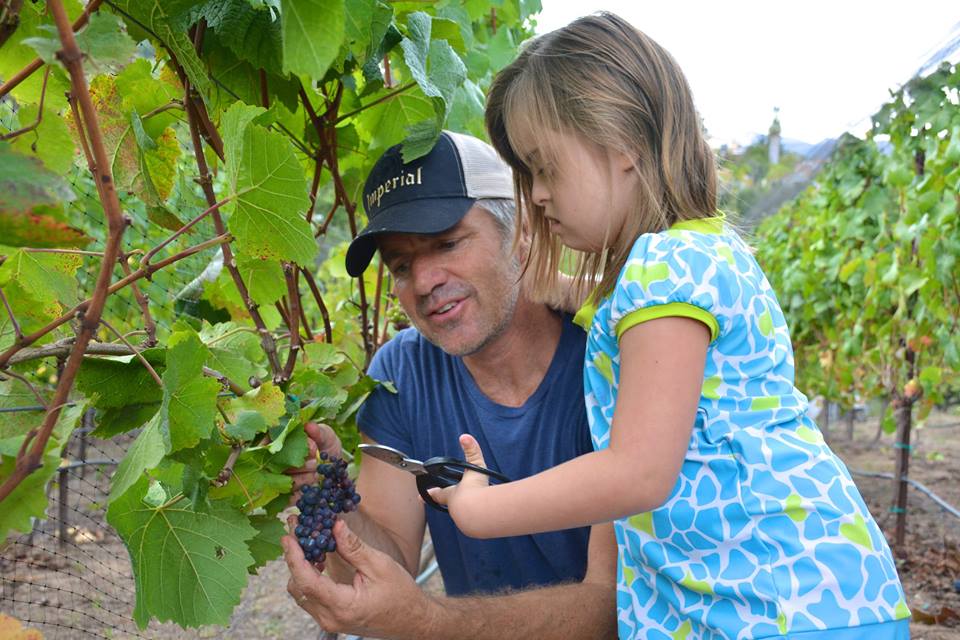
Each harvest, though, and even much of the physical labor that’s part of the process, is totally a family affair.  Tyler and Mia, themselves, are the crew, often with the help of their 11-year-old son, Tyson.  And even their 7-year-old daughter, Mylie, likes to roll up her sleeves.  “It was so cool seeing her help clip grape clusters during harvest last week,” her dad says.

And with Mylie is where this story takes a heartwarming turn.

Mylie, a beautiful and vivacious little girl, was born with Down syndrome.  “All the tests we took during the pregnancy came back negative,” Willson tells me.  “We didn’t find out the diagnosis until 24 hours after she was born.”  Mylie would see multiple hospitalizations and surgeries even before age two.

Mylie Willson frolics in her family's vineyard during the 2015 harvest

Necessity (and, as it turns out, serendipity) led the Willsons to Alpha Resource Center, the Santa Barbara nonprofit  that empowers developmentally challenged kids, teens and adults through diverse life skill training programs.  They help them secure housing, train for jobs and find a multitude of creative and recreational outlets.  Alpha impacts more than 2200 local families every day.

“They are such wonderful people,” says Willson.  “Not just for what they’ve done for us, but also for what they do for so many other people who can’t do it for themselves.”

Mylie helps her dad with harvest
Among the group’s resources is SlingShot, a working art gallery and studio at 220 W. Canon Perdido in Santa Barbara where dozens of program participants create and showcase their artwork in many forms.  Visitors get a chance to meet and mingle with the artists at work.  And proceeds from the sales of pieces on display here support Alpha’s ongoing work.

The Willsons bought a large painting from SlingShot a few years ago – a vibrant, energetic piece by artist Michael Constantine that they call “Impulse” and that now hangs prominently in their home.  “We looked at it and immediately thought, ‘That would make a great wine label!’” recalls Willson.  “And that’s when it clicked!”

Artistic inspiration, it turns out, would create a powerful way for the Willsons to give back.  “Impulse” became the label of the Willson Family Vineyards’ 2013 Pinot Noir, making each bottle eye-popping and special.  And with the ’14 pinot now in bottle, the Willsons are looking to select several other works of art – including a painting called “Poppy” by Alpha artist Megan Isaac – to grace the glass.

2015 pinot noir from the Willson Family Vineyard
So the Willson pinots have now become a powerful fundraising tool for Alpha Resource Center.  Wine tasting art shows have started to pop up all over town, most recently at Churchill Jewelers in downtown Santa Barbara.  And SlingShot is now part of First Thursday festivities in downtown Santa Barbara, drawing the public in off the street both with art on the walls and Willson pinot in the glass; the next event is Thursday, August 6th.

“We’re also working on a silent auction for next year,” Willson says, “where bidders can take home original works of art along with cases of our pinot that feature that same piece right on the label.”

For more information on Alpha Resource Center and SlingShot, visit www.alphasb.org.


###